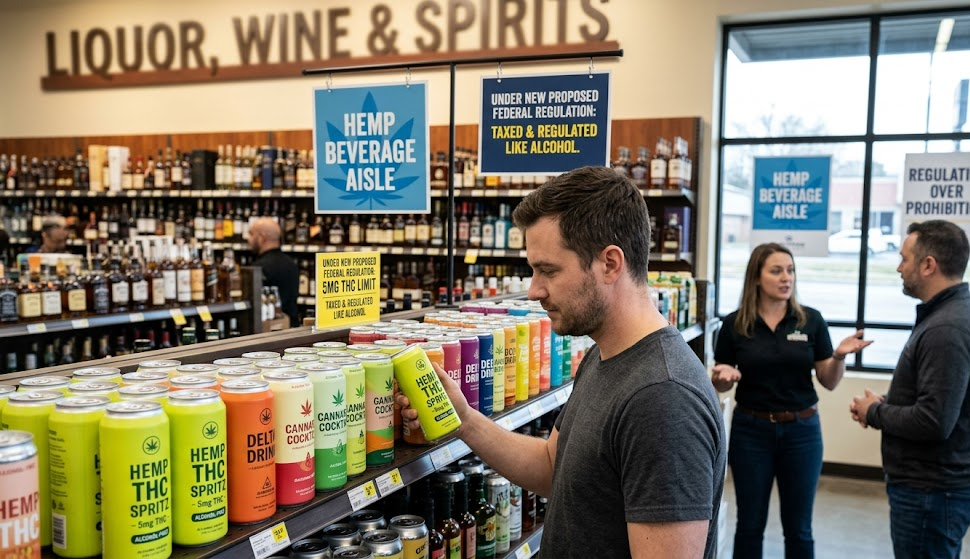
Big alcohol is officially raising a glass to hemp-infused drinks. Major wine, spirits, and beer retailers and wholesalers are throwing their political weight behind a new bipartisan bill in Congress that would keep hemp-derived THC beverages federally legal while bringing them directly into the alcohol regulatory fold.
The Beverage Regulatory Parity Act—introduced by Representatives Beth Van Duyne (R-TX) and Greg Landsman (D-OH)—aims to carve out a permanent legal home for low-dose THC drinks just as federal lawmakers prepare to execute a sweeping ban on hemp-derived cannabinoids.
From Ban Scramble to Regulatory Strategy
Under the 2018 Farm Bill, hemp derivatives with less than 0.3% delta-9 THC on a dry-weight basis became federally legal, opening the door for a booming market of hemp-infused sodas and seltzers. However, federal legislation signed late last year set up a strict total THC cap of 0.4 milligrams per container, which would effectively eliminate almost all commercial hemp THC drinks when it takes effect.
While the Senate recently voted to delay that ban’s effective date to give lawmakers more time to hash out a permanent framework, alcohol groups are stepping up to offer a long-term solution rather than total prohibition: treat hemp drinks like booze.
How the Proposed Framework Works
Instead of forcing hemp beverages into a legal gray area or outright banning them, the Van Duyne-Landsman bill establishes clear rules for production, taxation, and retail sales:
- Serving Caps: Beverages would be limited to a maximum of 5 milligrams of total intoxicating THC per serving, with multi-serving containers capped at 750 milliliters.
- Federal Tax: A new federal tax of 8 cents per milligram of intoxicating THC would be levied on hemp drinks.
- Agencies in Control: Oversight would fall under a coalition of federal authorities, including the Treasury Department’s Alcohol and Tobacco Tax and Trade Bureau (TTB), the Department of Health and Human Services (HHS), and the USDA.
- Strict Licensing & Sourcing: Manufacturers, wholesalers, and retailers would need federal permits, and products would have to use naturally occurring cannabinoids grown and processed in the United States.
- State Autonomy: States and tribal authorities retain the power to pass stricter local regulations, provided they do not block the interstate transit of compliant drinks through their borders.
Why Alcohol Industry Giants Are On Board
Industry trade groups, including the Wine & Spirits Wholesalers of America (WSWA) and the Beverage Alcohol Merchants Coalition (BAMCO)—which represents retail heavyweights like Total Wine & More, BevMo!, Spec’s, and ABC Fine Wine & Spirits—have warmly embraced the proposal.
For alcohol distributors and retailers, the bill provides a clear roadmap to sell a wildly popular consumer product without running afoul of federal law enforcement. Rather than fighting hemp beverages as competitors, mainstream distributors are preparing to leverage their existing supply chains, age-verification standards, and retail infrastructure to dominate the burgeoning adult-beverage market.
Dabbin-Dad Newsroom