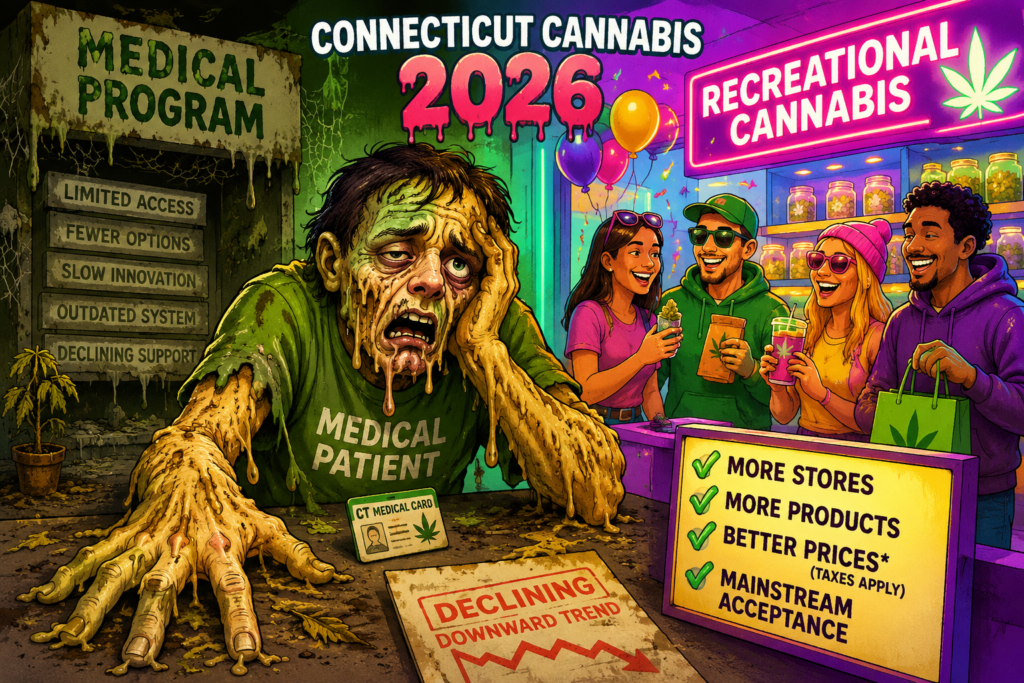
Something subtle has been happening in Connecticut’s cannabis system. Nothing dramatic. No sudden collapse. No official announcement. Just a steady shift that becomes harder to ignore the longer you look at it.
The medical marijuana program is still here in 2026, still operating, still legal, still functional. But it no longer feels like its own world. It feels like a smaller room inside a much larger building—one that’s being redesigned around it.
When recreational cannabis launched in Connecticut, it didn’t replace the medical system. It was built alongside it. For a while, the two existed in parallel: patients on one track, adult-use consumers on another, each with its own rules and expectations. But over time, those tracks started to merge in practice, even if they remain separate on paper.
Walk into a dispensary today and you’ll see what that means. The same counters, the same brands, the same flower jars, the same edibles. The distinction between medical and recreational isn’t something you feel in the room anymore—it’s something you learn at checkout, when taxes are applied or limits are enforced. The physical experience has largely converged, and that convergence has changed everything about how patients interact with the system.
One of the biggest forces behind this shift is simple behavior. As adult-use cannabis became widely available, many medical patients stopped renewing their cards. Not because access got worse, but because the incentive to stay in the system weakened. The recreational market became easier, faster, and in many cases, good enough. The medical registry began to shrink not from failure, but from irrelevance for a portion of users.
Cost is still the last real anchor holding the medical program in place. Medical cannabis remains tax-free in Connecticut, and that alone still matters. For people who use cannabis regularly, those savings add up in a meaningful way. But even that gap has narrowed as recreational pricing has become more competitive and stable. What was once a stark financial divide has turned into a quieter, more incremental difference.
Access tells a similar story. Medical patients technically still have advantages—higher purchase limits, priority treatment in hybrid stores, and some structural flexibility that recreational customers don’t get. But because both markets now flow through the same supply chain and the same storefronts, those differences feel less like separate systems and more like small rule adjustments inside a shared experience. The menu is no longer split in any meaningful way. It’s unified, and that unity flattens the old distinctions.
The deeper shift is happening behind the scenes, in how cannabis is produced and developed. As companies adjust to a larger recreational customer base, product innovation and supply naturally follow the money. Medical-specific development has slowed, not because it was intentionally deprioritized, but because the economics of a unified market reward scale over specialization. The result is a medical program that increasingly offers the same products as recreational channels, just under different rules.
All of this leads to a simple but important question for patients in 2026: does the medical card still make sense?
For people who use cannabis frequently, the answer is often yes. The tax exemption alone can justify the cost over time, and higher purchase limits still matter for patients who rely on consistent access. There is still a practical, financial logic to staying in the medical system if cannabis is part of your regular routine.
But for more casual users, the calculation is different. If cannabis is occasional, or if purchase amounts are small, the medical program starts to feel less like a necessity and more like an extra layer of bureaucracy on top of something that is already widely accessible.
What Connecticut is really moving toward is not the disappearance of medical cannabis, but its absorption into a broader recreational framework. The medical system is becoming less of a separate market and more of a discounted access tier within a single, unified cannabis economy. The structure still exists, but the separation is fading in practice.
And that’s the quiet truth of where things stand in 2026. The medical marijuana program hasn’t failed. It hasn’t disappeared. It’s just slowly being folded into something larger, where the line between patient and consumer is thinner than it has ever been.
Dabbin-Dad Newsroom