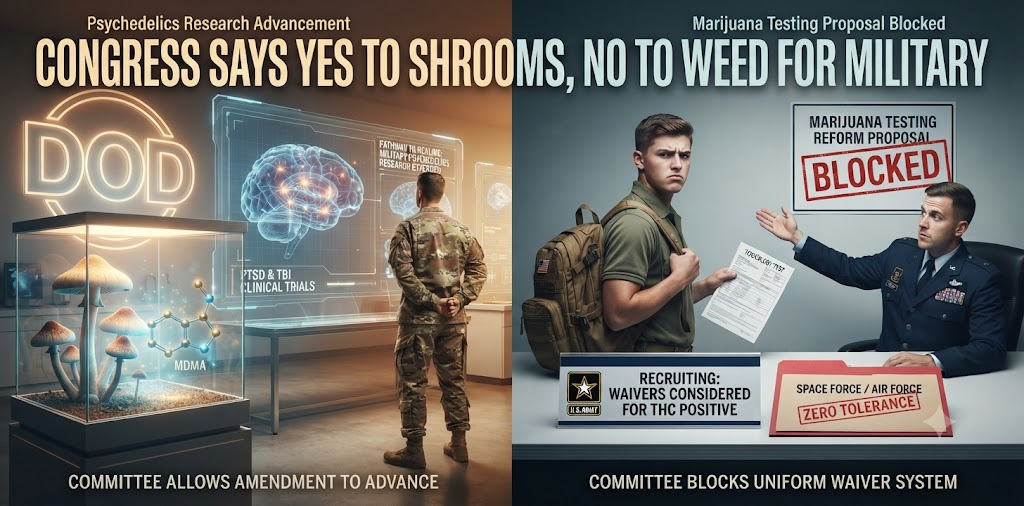
The halls of Congress are proving once again that drug policy is a game of selective priorities. This week, the House Rules Committee took a hard look at the National Defense Authorization Act (NDAA) and decided that while they are officially ready to explore the potential of mind-altering substances to heal our troops, they aren’t quite ready to stop sweating over a recruit’s weekend joint.
In a move that feels like a scene out of a pragmatic fever dream, a bipartisan group of lawmakers successfully pushed through an amendment to extend a Department of Defense research program focused on psychedelics. The project, which investigates how substances like psilocybin, MDMA, and ibogaine can help service members grappling with PTSD and traumatic brain injuries, is getting a massive legislative runway. If the broader bill passes, this push for “heroic doses” as a medical intervention will be authorized to continue through 2033, signaling that lawmakers are increasingly comfortable with the idea of the military embracing unconventional science to tackle mental health crises.
Yet, that progressive energy hit a brick wall the moment the conversation shifted to marijuana. A common-sense proposal aimed at curbing military recruitment woes—which would have forced the Air Force, Space Force, and Marine Corps to adopt a standardized waiver system for recruits who test positive for THC—was unceremoniously shelved by the Rules Committee. Despite the Army and Navy already having success with similar waiver programs, the committee blocked the measure, leaving those branches to continue their zero-tolerance stance while struggling to meet readiness goals.
The committee also signaled a firm “not yet” to a bipartisan attempt to expand federal “Right to Try” laws. That proposal, championed by Reps. Madeleine Dean and Nancy Mace, aimed to allow doctors to administer Schedule I psychedelics to patients facing life-threatening conditions. By creating a regulatory pathway for the DEA to register physicians for this work, the amendment sought to bridge the gap between the FDA’s own “breakthrough therapy” designations and the current reality of federal prohibition. But for now, that door remains firmly shut.
Ultimately, the committee’s decision highlights a weirdly specific new era in Washington: Congress is perfectly willing to back cutting-edge, psychedelic-assisted mental health research for soldiers, but when it comes to the blunt reality of marijuana in the recruitment office, the brass still prefers to pretend it’s 1955.
Dabbin-Dad Newsroom