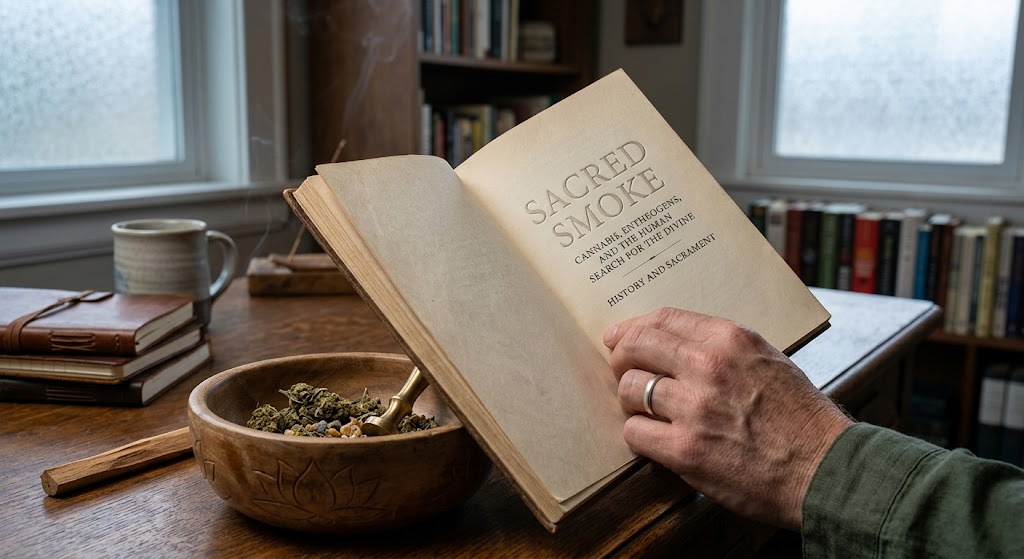
Long before cannabis became a multi-billion-dollar commercial commodity or the subject of twentieth-century prohibitions, it existed in human culture as an entheogen—a psychoactive substance ingested within an intentional spiritual, religious, or shamanic framework to facilitate transcendent experience, ecstatic visionary states, and direct communion with the divine. Across millennia and spanning distinct continents, ancient societies rarely reduced the botanical specimen to a secular intoxicant. Instead, they venerated it as an ontological bridge: an herbal catalyst capable of stilling the chatter of the mundane ego, harmonizing internal human energy with cosmic rhythms, and piercing the veil between physical terrestrial existence and metaphysical reality.
The Vedic Fountainhead and the Cult of Mahadeva
Nowhere in the historical record is the spiritual veneration of cannabis older, more philosophically articulated, or more continuously observed than across the Indian subcontinent. The earliest textual veneration appears in the sacred verses of the Atharva Veda, compiled roughly between 1400 and 1000 BCE, wherein cannabis is lauded as one of the five sacred plant kingdoms that liberate humanity from anxiety, distress, and karmic burdens. Within the vast tapestry of Hindu mythos, the plant is inextricably linked to Lord Shiva, the primordial yogi, cosmic ascetic, and deity presiding over destruction, transformation, and unfathomable meditative absorption.
Cosmological lore explains this intimate bond through the pivotal narrative of the Samudra Manthan, or the Churning of the Ocean of Milk. According to Vedic tradition, when the deities and demons joined forces to churn the cosmic waters to extract amrita, the elixir of eternal life, drops of this celestial nectar splattered upon the terrestrial crust, germinating into the cannabis plant. A parallel narrative recounts that when Shiva consumed Halahala, the virulent poison that threatened to incinerate the universe, the toxicity burned with an agony so profound that it stained his throat indigo; to temper this inner conflagration, Goddess Parvati and the celestial sages prepared cooling preparations of cannabis, providing the Great God with immediate relief.
This ancient mythology remains entirely alive today among wandering ascetics known as sadhus and the wider lay community. Devotees routinely ingest bhang, an emerald paste ground from fresh leaves and floral clusters, meticulously blended into chilled cow’s milk enriched with almonds, black peppercorns, rose water, and raw sugar. This sacred potion forms the spiritual heart of the exuberant spring festival of Holi and the nocturnal vigil of Maha Shivaratri. Simultaneously, renunciants smoke charas, a concentrated hand-rubbed resin, through clay chillums. Before inhaling, the sadhu raises the pipe toward the brow and intones “Jai Bholenath”—praising Shiva as the Lord of Innocence. This act functions not as an indulgence in sensory pleasure, but as a deliberate yogic practice designed to incinerate egoic identity, conquer sensory distractions, and fix contemplative attention entirely on Brahman, the ultimate cosmic reality.
Incense Altars and the Ancient Levantine Sanctuary
For generations, academic historians assumed that the historical religious traditions of the Near East were insulated from psychoactive plant culture. However, contemporary archaeological science has dismantled this assumption. In 2020, researchers conducting chemical residue analysis on artifacts recovered from the eighth-century BCE royal shrine at Tel Arad in modern Israel unveiled direct physical evidence of cannabis use within an ancient Judahite place of worship. The inner sanctum, structured in design after the First Temple of Jerusalem, housed two limestone incense altars placed at the threshold of the Holy of Holies. While the larger monolith bore residue of frankincense emulsified with animal fats, the smaller altar tested positive for concentrated cannabinoid resin blended with dried dung to fuel low-temperature vaporization. This landmark discovery confirmed that psychoactive cannabis smoke was actively deployed in sacred ceremonies within the Kingdom of Judah to facilitate ecstatic religious awe and divine manifestation.
This material breakthrough has re-energized linguistic examinations of the Hebrew Bible, most notably around the enigmatic compound kaneh-bosm, translated in Exodus 30:23 as fragrant cane, sweet calamus, or sweet reed. In that foundational passage, Yahweh delivers explicit instructions to Moses regarding the compounding of the holy anointing oil, intended to consecrate the Tent of Meeting, the Ark of the Covenant, and the hereditary Aaronic priesthood. Anthropological linguists, spearheaded by Sula Benet, have maintained that kaneh-bosm represents the etymological Semitic ancestor of the Scythian and Greek term kannabis. If this etymological lineage holds, the ancient Tabernacle was perpetually steeped in an aromatic, cannabinoid-saturated transdermal pomade designed to mark sacred personnel and consecrate ritual instruments.
The Nomadic Pyres of the Eurasian Steppes
Far to the north, across the windswept Eurasian steppes, cannabis functioned as a powerful funerary technology connecting nomadic tribes to the realm of ancestral spirits. In the fifth century BCE, the Greek chronicler Herodotus dedicated chapters of his Histories to documenting the peculiar purificatory rites of the Scythians following the burial of their chieftains. Herodotus recorded that the nomads would erect small tripartite wooden wigwams bound with woolen felt, crawl within the miniature shelters, and throw wild hemp flowers and seeds upon white-hot river rocks. The resulting vapor, as Herodotus observed, produced clouds denser than any Greek steam bath, prompting the celebrants to weep, chant, and shout for joy as the psychoactive vapor permeated their senses.
For centuries, Western scholars viewed Herodotus’s narrative with skepticism, dismissing it as imaginative travel folklore. Yet modern paleopathology and archaeology in the Altai Mountains have validated his observations. Excavations of frozen iron-age burial tumuli at Pazyryk unearthed preserved larch-wood poles, felt tent coverings, bronze cauldrons containing scorched stones, and elaborately sewn leather pouches packed with desiccated cannabis inflorescences. For these horse-riding pastoralists, inhaling the concentrated essence of the plant during mortuary observances was an essential communal sacrament, serving to honor fallen leaders, purge ritual pollution, and facilitate the dangerous crossing between life and death.
Ecstatic Sufism and the Green Leaf of the Dervish
When Islamic orthodoxy consolidated across the Middle East and North Africa, jurisprudence imposed rigid bans against alcohol, categorized under the religious proscription of khamr. Yet within the non-conformist, mystical fringes of Sufism, particularly among the antinomian Qalandar orders and wandering dervishes of the twelfth and thirteenth centuries, cannabis found a complex spiritual refuge. These esoteric wanderers, grouped around legendary ascetics such as the Persian saint Sheikh Haydar of Khorasan, recognized in the resin of hashish an inward portal distinct from the coarse aggression associated with wine.
For these traveling mystics, the plant—frequently described in mystical poetry as the Green Leaf or the emerald jewel of heaven—acted as a tool to achieve fana, the voluntary annihilation of the individual self within the overwhelming majesty of God. Unlike worldly indulgence, the dervishes consumed hashish in intentional solitude or within tight-knit fraternal circles to extinguish worldly vanity, silence secular ambition, and invite spiritual contemplation. Although mainstream orthodox jurists consistently issued blistering theological condemnations, prosecuting the practice as an insidious heresy, the wandering poets persisted in defending the herb as a quiet, introspective mirror that liberated the wandering soul from earthly constraints without fracturing moral dignity.
The Sacramental Chalice of the Rastafari
In contemporary religious history, the most prominent fusion of theology and cannabis exists within the Rastafari movement, which emerged across the impoverished rural villages and urban settlements of 1930s Jamaica. Within this Afrocentric socio-spiritual liberation movement, cannabis is universally venerated under the name ganja, a linguistic gift bequeathed by the thousands of Indian indentured laborers who arrived in the Caribbean throughout the nineteenth century. For the devout Rasta, cannabis is neither an escape nor a recreational novelty, but the holy herb of healing and the singular sacrament of the faith.
The theological legitimacy of the herb is anchored directly in Christian scripture, with practitioners citing Genesis 1:29, which declares that humanity has been granted every seed-bearing plant that grows upon the face of the earth, alongside passages from the Book of Revelation that extol the leaves of the celestial tree for the healing of the nations. In practice, the community gathers for communal assemblies known as reasoning sessions. During these meetings, participants sit in sacred circle, bypass conventional societal hierarchies, and pass the chalice—a water pipe often constructed from a dried coconut shell and wooden stem. Before drawing the smoke, the bearer recites an earnest prayer dedicated to Jah Rastafari, consecrating the inhalation as an act of communion designed to burn away the deceptive indoctrination of Babylon, illuminate internal truth, and foster livity, the continuous pursuit of peaceful, righteous, and ecologically harmonious existence.
Modern Jurisprudence, Religious Freedom, and the Neo-Sacrament
The ancient conversation surrounding cannabis and spirituality has transitioned into modern constitutional law, transforming secular courtrooms into contemporary theological arenas. In the United States, religious organizations frequently challenge federal and state narcotics statutes by invoking the Religious Freedom Restoration Act. Litigants ranging from established Rastafari coalitions to newer groups such as the Hawaii-based Ministry of Cannabis seek legal protections identical to those long granted to the Native American Church for their sacramental consumption of peyote cactus. Although judiciary panels have historically set exceptionally high evidential bars for proving sincere religious adherence versus secular recreation, the struggle remains an active legal battleground.
Concurrently, independent entheogenic assemblies such as the Church of Cognizance and the Elevation Ministries have organized explicitly around cannabis consumption, asserting that communal puffing serves as their primary conduit for mindfulness, fellowship, and First Amendment-protected worship. Internationally, the paradigm has begun to tip toward formal state recognition. In nations such as Antigua and Barbuda, progressive legislative overhauls have codified explicit legal exemptions allowing Rastafarians to cultivate, possess, and burn their holy herb unmolested by police authorities, acknowledging that decades of state-sponsored prohibition represented an unconstitutional violation of foundational human rights.
Across thousands of years of shifting empires, transforming languages, and evolving world religions, the fundamental human impulse to use cannabis within a sanctuary setting has remained remarkably consistent. Whether consumed as spiced, frothing bhang on the river ghats of Varanasi, combusted on white-hot stones inside felt tents along the Eurasian steppe, vaporized atop limestone altars in ancient Levantine temples, or drawn through an oiled chalice in the hills of Jamaica, the plant has served as a resilient contemplative companion. Its enduring sacred history reveals humanity’s persistent, creative drive to look beyond material reality and seek profound communion with the divine.
Dabbin-Dad Newsroom