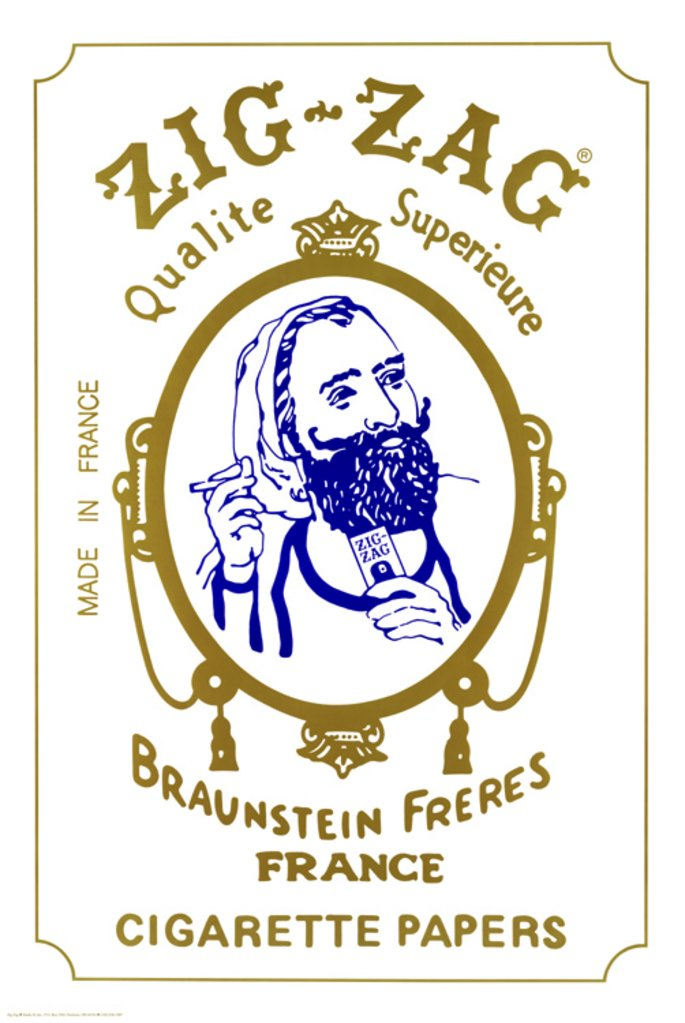
You already know his face. Whether he’s winking at you from behind a bodega counter, etched into a forearm as a flash tattoo, printed on a vintage rap tee, or even strutting down a Paris runway, the mustachioed man in the slouchy beanie is everywhere.
He’s not just a brand mascot—he’s a folk hero, a cultural phenomenon, and arguably the patron saint of rolling up.
He’s appeared on psychedelic rock posters, inspired some of the greatest hip-hop album covers of all time, and earned a list of nicknames to rival any pop culture icon. Yet, the wildest part about the Zig-Zag Man? He’s been quietly building his legend for over 145 years—long before dispensaries, hip-hop, or the counterculture even existed.
From the Battlefield to the Booklet
Every legend has an origin story, and the Zig-Zag Man’s begins with war, tobacco, and some serious on-the-fly improvisation.
The man staring back at you from the pack is officially known as Le Zouave, inspired by the elite French infantry soldiers of the Crimean War. As company lore has it, during the grueling 1850s Battle of Sevastopol, a Zouave soldier was enjoying a smoke when a stray bullet shattered his clay pipe.
Most would have considered that a lost cause. But not this soldier. Thinking on his feet, he tore a piece of paper from his gunpowder cartridge pouch, sprinkled in some loose tobacco, rolled it up, and sparked it. Necessity had officially given birth to invention.
Decades later, French brothers Jacques and Maurice Braunstein adopted the image of this resourceful soldier to front their new rolling paper company. They also patented a genius interleaving process that allowed papers to dispense one after the other in a “Z” formation. They named the brand Zig-Zag, and just like that, a battlefield hack became one of the most recognizable icons in global smoking culture.
The Mascot Becomes Mythology
While every brand has a logo, very few cross the threshold into true iconography. As cannabis culture blossomed in America—moving from jazz clubs to college dorms to music festivals—Le Zouave evolved. Passing a pack of Zig-Zags became a subtle handshake, an unspoken “if you know, you know.”
Across the country, smokers began giving him nicknames. Some called him “The Captain” (a nod to a 1960s ad campaign), while others endearingly dubbed him “Weed Jesus.” No one knows exactly where the latter came from, but it perfectly captured the cultural reverence he commanded.
A Badge of the Counterculture
By the 1960s, the Zig-Zag Man was speaking the language of the counterculture fluently. In 1966, legendary psychedelic artists Alton Kelley and Stanley Mouse placed him front-and-center on a concert poster for Big Brother and the Holding Company (fronted by Janis Joplin).
Around the same time, tattoo pioneer Milton Zeis drew up the first known Zig-Zag flash tattoo. “The Captain” had transformed from packaging art to a permanent badge of identity. Recognizing this enduring bond, Zig-Zag launched its “Zig-Zag for Life” campaign in 2025, rewarding die-hard fans with real Zig-Zag tattoos and a lifetime supply of cones.
Hip-Hop Immortality
If the 1960s embraced the Zig-Zag Man, the 1990s canonized him. In hip-hop, the brand’s unmistakable aesthetic became a visual shorthand for authenticity.
In 1988, Eazy-E leaned into the Zig-Zag design for his We Want Eazy artwork. But the ultimate homage came in 1992, when Dr. Dre dropped The Chronic. The album cover—one of the most famous in music history—was a direct, unapologetic tribute to the classic Zig-Zag pack.
The references quickly bled into the lyrics. Snoop Dogg famously spit, “Doggy Dogg is all about the Zig-Zag smoke,” while Afroman immortalized the brand globally with the hook, “Colt 45 and two Zig-Zags.” From Eminem to Tyler, The Creator, hip-hop royalty has kept Le Zouave in heavy rotation ever since.
Still Rolling, Still Relevant
Lots of legacy brands have history, but very few maintain their relevance. Today, Zig-Zag sits at the rare intersection of old-school heritage and modern luxury.
Beyond their iconic French Orange and Original White booklets, Zig-Zag has evolved to meet the modern smoker with unbleached and organic hemp papers, as well as convenient pre-rolled cones. And the Captain’s influence continues to stretch far beyond the smoke shop. Luxury jeweler Chrome Hearts famously crafted a sterling silver Zig-Zag rolling machine that trades for eye-watering prices today, and fashion house Amiri recently infused Le Zouave into their Paris runway designs.
Whether it’s West Coast rap, tattoo parlors, high fashion, or psychedelic rock, the Zig-Zag Man is right at home.
Life’s Fast. Burn Slow.
For over a century, the Zig-Zag Man has floated seamlessly through generations and creative movements while staying exactly who he is: part folk hero, part cultural anchor, and the ultimate co-pilot for a perfect session.
In 2026, Zig-Zag kicked off a new campaign titled “Life’s Fast. Burn Slow.” It’s a reminder that in a hyper-accelerated world, the simple, intentional act of rolling up is one of the best ways to slow down, ground yourself, and be present.
So next time you crack open a fresh orange pack or pack a cone, give a nod to the Captain. After all, he’s been keeping the culture rolling since day one.
Dabbin-Dad Newsroom