There I was — thumb numb, brain half-fried — doing what any responsible adult does after coffee in the mornig: doom-scrolling through cannabis Twitters and industry feeds looking for something between enlightenment and blood pressure spikes.
And then I hit it.
A graphic showing Northeast cultivator rankings. Vermont sitting up top with nearly 400 licensed growers. New York with a couple hundred. Massachusetts triple digits. Even Maine flexing decent numbers.
And then…
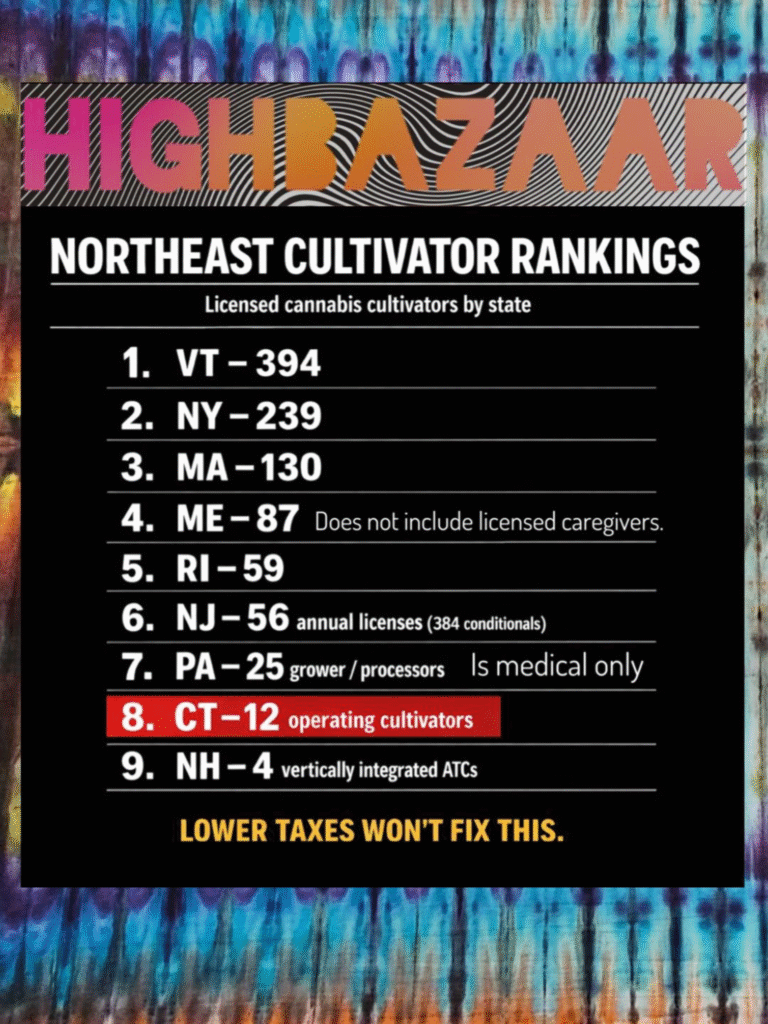
Connecticut — #8 — with 12 cultivators.
Twelve.
Not twelve hundred.
Not a typo.
Twelve operating cultivators in an entire adult-use market.
Cue the record scratch.
I saw a comment under the picture posted on Facebook from Joseph Raymond (HighBazaar/CraftCannabisAlliance) that pretty much summed up the vibe:
“Keep your friends rich and the prices high. That is the philosophy of legal cannabis in Connecticut.”
And look — you don’t need a PhD in market dynamics to read between those lines. When you can count the number of producers on your fingers, that’s not a marketplace — that’s a velvet-rope club.
The MSO Elephant in the Grow Room
Let’s call it what it is. This isn’t a scrappy ecosystem of local cultivators swapping soil tips and arguing terpene profiles at the farmers market. This is largely controlled by multi-state operators — corporate entities whose idea of “craft” is whatever fits into quarterly earnings calls.
And here’s the question nobody wants to say out loud:
Where are the mom-and-pop growers?
Oh right — they don’t exist. Never did. Not here…
That should tell you everything you need to know.
Because if legalization was supposed to open doors, empower local entrepreneurship, and diversify supply — yet the end result is consolidation, mergers, acquisitions, and shrinking access — then we didn’t build a community market.
We built a gated subdivision.
Scarcity Isn’t an Accident
Limited licenses create predictable outcomes:
- Higher barriers to entry
- Consolidation of power
- Less competition
- Less innovation
- And — surprise — prices that don’t exactly race toward affordability
This isn’t conspiracy talk. It’s economics 101 with a weed sticker slapped on it.
Meanwhile states with broader cultivation access are seeing experimentation, regional identity, and small-operator flavor creep into the culture. Messy? Sure. But alive.
Twelve cultivators doesn’t feel alive.
It feels curated.
Final Doomscroll Thought
Now maybe Connecticut will evolve. Markets do mature. Regulations shift. Access expands.
But right now?
Scrolling past that ranking felt less like reading data and more like stumbling onto a scoreboard showing who actually got invited to this party — and who got left standing on the other side of the velvet rope.
Anyway… that was today’s doomscroll rabbit hole.
I’m going to put the phone down before I accidentally learn something else that ruins my mood.
Keep it Weird,