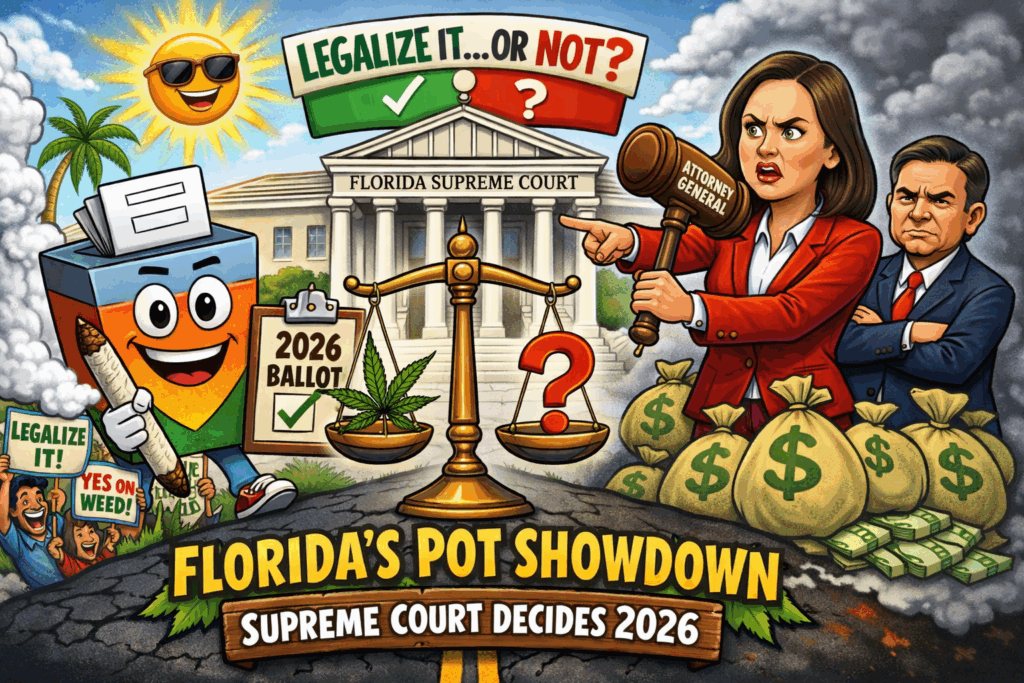
Florida is once again at the center of a heated legal showdown over cannabis. The state’s attorney general has asked the Florida Supreme Court to review the constitutionality of a proposed marijuana legalization initiative aimed at the 2026 ballot. The court has accepted the request, setting deadlines for state officials and campaign representatives to file briefs in the coming weeks.
The measure, spearheaded by the advocacy group Smart & Safe Florida, has already gathered over a million signatures, signaling strong grassroots support. Yet, the path to the ballot has been anything but smooth. Campaign organizers have challenged delays in the certification process, arguing that the state should have advanced the initiative sooner once an initial signature threshold was met. Meanwhile, a separate legal dispute over roughly 200,000 potentially invalidated signatures adds another layer of uncertainty.
Florida’s political landscape further complicates the picture. Governor Ron DeSantis, a longtime opponent of marijuana legalization, has cast doubt on the initiative’s prospects, suggesting it could face insurmountable hurdles in the courts. Past efforts saw a majority of voters in favor of legalization, but the measure fell short of the 60 percent threshold required to amend the state constitution.
Amid these legal maneuvers, the campaign received a key win when a judge struck down restrictions on signature collection, a ruling that could prove crucial in keeping the initiative alive. Still, questions linger about funding and political interference, with past allegations surfacing over donations used to oppose citizen-led cannabis reforms.
As the clock ticks toward the 2026 election, Florida’s marijuana legalization battle is shaping up to be a high-stakes clash between grassroots activism, state politics, and the courts. The Sunshine State may soon decide whether voters—or legal challenges—ultimately determine the future of cannabis.
Dabbin-Dad Newsroom